
The Golden Age of Inline-4 Motorcycles: 1909-1942
May 21, 2027—Oct 18, 2027
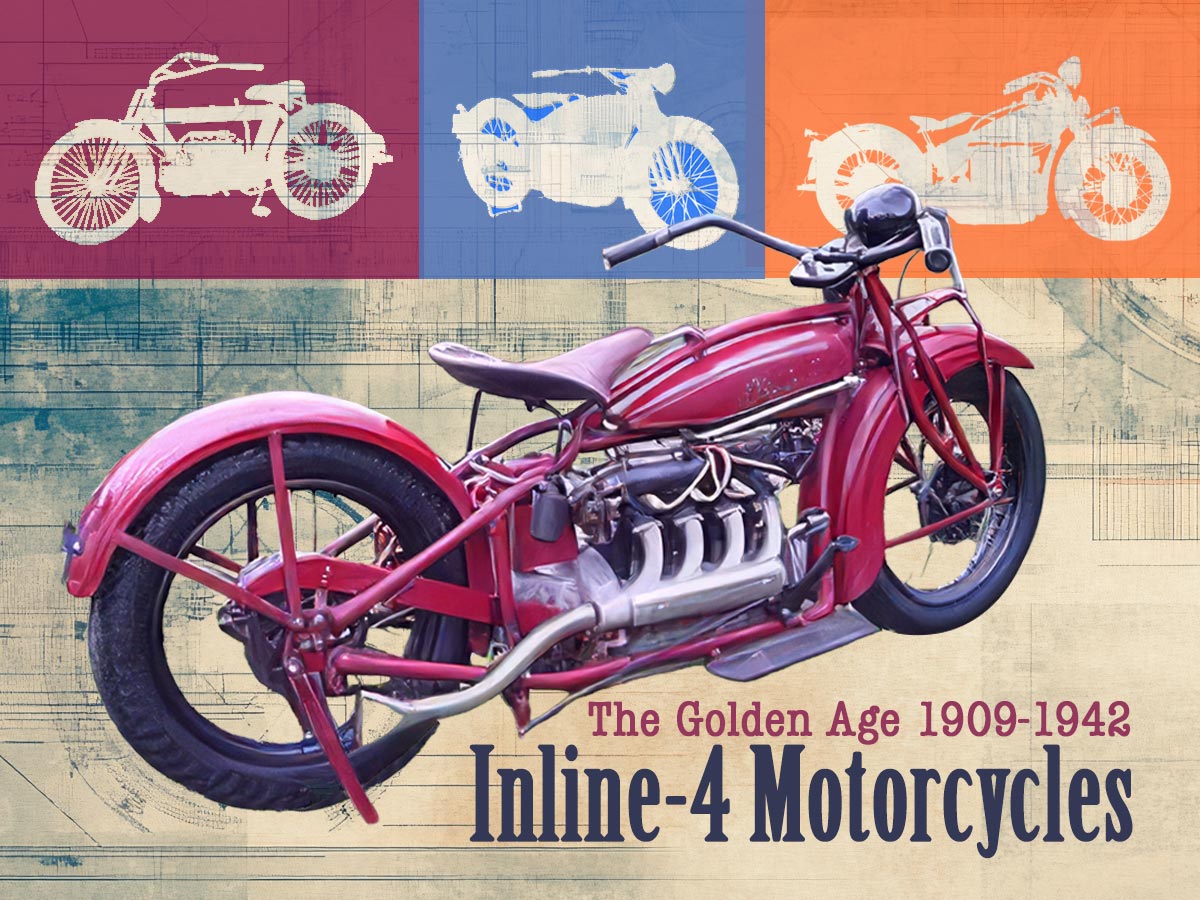
Location: Throughout the Museum
The inline-4 motorcycle legacy is deeply rooted in motorcycling history. Guest curator Joe Ritchey showcases a superb array of inline-4 examples. The exhibit features motorcycles from 1909 to1942, along with stories, history, and timelines.
What is an Inline-4 cylinder motorcycle?
Inline-4 cylinder motorcycles feature four cylinders arranged in a straight line on a common crankshaft. Most American fours from 1909–1942 mounted the engine lengthwise (longitudinally) in the frame rather than across it.
The Golden Age
During the golden era of American multi-cylinder engineering, four-cylinder motorcycles represented the absolute pinnacle of luxury, speed, and mechanical prestige. Rather than the harsh vibration of V-twins, these “luxury land-yachts” offered automotive-grade smoothness. From 1909 to 1942, the American four-cylinder motorcycle market served as a premium, high-performance niche for an elite class of riders, sports enthusiasts, and police departments. Powered by longitudinal inline-four engines, these machines earned the nicknames “Duesenbergs” and “Cadillacs” for their exceptionally smooth power delivery. Because of their high top speeds and reliability, highway police patrols and wealthy long-distance tourers were the primary buyers.
Inline-4 Production Ceases
Years for Vintage Inline-4 Models
- Indian Four (1928–1942)
- Henderson Four (1912–1931)
- Ace (1919–1927)
- Pierce Four (1909–1912)
- FN Four (1904–1926)
- Brough Superior Four (1928–1930s)
The Inline-4’s 33-year Era: Progression and Phases
The Pioneer Era (1909–1911)
The Four-Cylinder market began with a focus on unmatched smoothness to counter the heavy vibrations of early single-cylinder and V-twin engines. In 1909, the Pierce Cycle Company of Buffalo, New York, a division of the Pierce-Arrow luxury car manufacturer, introduced their Pierce Four, America’s first four-cylinder motorcycle. Inspired by Belgium's FN Four. It offered radical innovations like a stressed-member engine, shaft drive, and a large-tubing frame that housed oil and fuel internally. Despite strong engineering advantages, these bikes were specifically marketed to prosperous “sportsmen.” Selling for $325 to $400 at a time when standard motorcycles cost $150, and Henry Ford’s Model T dropped to $260, the market was financially unsustainable. Pierce Motorcycles went bankrupt by 1914, having produced less than 500 units, and their factory redirected manufacturing resources to the emerging World War in Europe.
The Henderson Era (1912–1917)
William G. Henderson was widely considered the genius and Godfather of the American four-cylinder motorcycle. Together with his brother Tom, William Henderson launched the Henderson Motorcycle Company in 1912. Although their machine became the market’s gold standard, their boutique engineering struggled to scale. By mid-1917, economic stresses from the expanding European war crept into the US economy and the market began consolidating. Ignaz Schwinn (owner of Excelsior) bought the Henderson company on November 17, 1917, and moved production to Chicago. William Henderson stayed on as Chief Engineer and Tom as
General Sales Manager. Both brothers resigned in 1919.
Schwinn’s Hendersons (1918 – 1931)
Schwinn’s engineering team of Arthur O. Lemon and Arthur “Connie” Constantine grew Henderson’s machine in size and horsepower into 1931. Focusing on reliability, mechanical strength, and massive air-cooling upgrades, the Model K and De Luxe series became absolute favorite choices for American police departments throughout the 1920s. The Henderson KJ / KL series introduced in April 1929 was considered the absolute masterpiece of Art Deco design and engineering. Boasting 40 horsepower and the ability to exceed 100 mph, it was incredibly popular
with luxury sports riders and police departments. Even after the Wall Street crash of October 1929, Henderson sales remained surprisingly strong due to their premium status and lucrative government police contracts.
The company came to a sudden end when Ignaz Schwinn correctly anticipated the severe economic depression would last for many years. Schwinn famously and abruptly called a meeting of his department heads and announced, “Gentlemen, today we stop.” Without warning, motorcycle production ceased instantly, effectively ending the Henderson brand and shrinking America’s “Big Three” motorcycle makers down to just Harley-Davidson and Indian. He was unwilling to risk his core business on an expensive luxury product during a time of widespread financial collapse. Schwinn made the calculated decision to consolidate its manufacturing power into a more stable, affordable, high-demand product: bicycles. This pivot ultimately preserved the “Schwinn” brand name for decades.
The Ace Era (1920-1926)
In 1919, Henderson left Henderson Motorcycle Company due to design disagreements with its new owner, Ignaz Schwinn. Henderson's focus on “power allied with lightness” was in direct conflict with Schwinn’s desire to produce a reliable and indestructible but heavy sidecar-capable machine, hoping to attract police and fleet contracts. Along with financier Max M. Sladkin of the Haverford Cycle Co., he founded the Ace Motor Corporation in the fall of 1919 at Philadelphia PA. His lightweight and powerful Ace Four became renowned as the fastest and most elegant motorcycle of its time. On December 11, 1922, while test-riding the new Ace Sporting Solo model,
Henderson was struck and killed by an automobile. His death dealt a massive blow to the company, stripping it of its primary visionary, leader, and engineering driving force. Despite efforts by Henderson’s protégé, Arthur Lemon, to keep the bike alive, the company completely lost its momentum and direction. The company could no longer balance its intensive manufacturing costs with sustainable retail pricing, triggering bankruptcy and subsequent liquidation. After its 1924 bankruptcy, the company’s assets and name changed hands among various investors over a few chaotic years until January 1927, when Indian acquired the assets.
The Cleveland Four (1925-1929)
The Cleveland four-cylinder motorcycle was a premium, high-performance machine produced from 1925 to 1929. It marked a radical pivot for the Cleveland Motorcycle Manufacturing Company, transforming it from a builder of cheap, lightweight commuter bikes into a manufacturer of the fastest luxury motorcycles in America. Wanting a piece of the luxury market, Cleveland hired designer L.E. “Burt” Fowler (formerly of Detroit’s Militor motorcycle company) to build their first multi-cylinder machine. Released in late 1925, the 600cc T-head Four was heavily patterned after
the old 1909 Pierce Four. However, it was severely underpowered and slow compared to its rivals, and it was a commercial failure. Realizing they needed real power, Cleveland hired engineer Everett DeLong, a veteran who had previously worked for both Henderson and Ace. DeLong completely scrapped the Fowler engine and designed a much larger, modern 750cc (45 cubic inch) F-head (inlet-over-exhaust) motor. Dubbed the “Cleveland 4-45,” this model completely turned the company’s reputation around. It featured an innovative gearbox design that allowed mechanics to remove internal gears from the side without pulling the entire engine out of the frame. In 1928, DeLong scaled up the engine again to create the Model 4-61, a massive 1,000cc (61 cubic inch) powerhouse. This model cemented Cleveland as a true engineering innovator. The 4-61 was the first American production motorcycle to feature a front-wheel drum brake. It was also among the first to include an integrated side stand. The bike could effortlessly cruise at 90 mph. In 1929, Cleveland released its ultimate masterpiece: the Tornado. This model featured a lowered, aggressive chassis and a heavily optimized version of the 1,000cc engine. The Tornado was factory-certified to exceed 100 mph, making it the absolute fastest road-going production motorcycle in the United States at the time. Despite having the fastest and most technologically advanced motorcycle on the market, Cleveland ran out of time. Following their failure to complete an agreement of sale to Harley-Davidson and the Wall Street Crash of October 1929, when luxury discretionary spending dried up instantly, the parent company (which also held industrial steel tubing contracts) decided to cut its losses and abruptly liquidated the motorcycle
division before the year ended.
Harley-Davidson (1928)
Harley-Davidson, famous strictly for its rugged V-twin engines, had absolutely nothing in its lineup to compete with a luxury inline-four. Buying Cleveland offered Harley-Davidson a ready-made, turnkey solution. By absorbing Cleveland’s tooling and engineer Everett DeLong's newly upgraded 1,000cc powerplant, Harley could have brought an advanced four-cylinder to market almost overnight to directly neutralize Indian's threat. Despite the immense appeal of neutralizing Indian, Harley-Davidson’s leadership ultimately rejected the buyout package due to these key operational and financial realities:
The desire for In-House Engineering:
Harley-Davidson prided itself on total control over its mechanical lineage. Leadership decided they would rather focus their resources on developing their own advanced configurations rather tha adopting an outsourced, foreign engine architecture.
Cleveland's Fragile Finances:
By 1928, Cleveland was deeply in debt. Their costly transition from cheap lightweights to high-end luxury fours had drained their reserves, making the buyout a highly risky financial venture for Harley to absorb.
V-Twin Loyalty:
Harley-Davidson’s manufacturing infrastructure and brand identity were entirely optimized for V-twin production. Retooling part of its Milwaukee operations for an inline-four would have been an incredibly expensive logistical distraction.
After Harley-Davidson formally passed on the offer, Cleveland pushed forward alone, pouring their remaining capital into developing the legendary, 100-mph Tornado. Had Harley-Davidson bought Cleveland, historians note that the “Big Three”; of American motorcycling might have looked very different, and Harley-Davidson would likely have produced its own legendary line of smooth, multi-cylinder luxury cruisers throughout the 1930s.
The Indian Era (1927–1942)
In the late 1920s, the American motorcycle market was rapidly consolidating into a fierce arms race. When the Indian “Motocycle” Company purchased the remains of the Ace Motor Corporation in late January 1927, it instantly gained a massive strategic advantage. Rebadging the luxury inline-four as the “Indian Ace,” Indian could suddenly target affluent riders who wanted smooth, multi-cylinder prestige. Indian acquired the Ace assets in January 1927 and began production in Springfield, MA, on March 21, 1927. Production of the “Indian-Ace” continued into 1928 when Arthur O. Lemon led the Indian Ace Four through its transformation to the iconic Indian Four. From 1927 through 1942, the Indian Four evolved from a stripped-down, lightweight sports machine into
a heavy, ultra-luxurious, and highly styled touring motorcycle. The year 1940 marked the most radical design transformation in the motorcycle’s history, pivoting completely toward heavy luxury touring. Indian introduced a dual-plunger rear suspension system with coil springs, drastically increasing rider comfort on highways. Indian introduced massive, deeply valanced, skirted fenders that covered nearly half of the new 16” balloon tires, giving the final models an imposing, heavy visual footprint. Sadly, the American Four-Cylinder market abruptly ended in 1942 as the United States fully entered World War II and Indian ceased civilian production to fulfill military contracts. After the war, high production costs and a post-war consumer preference for simpler V-twins meant the complex American inline-four never returned, closing this unique chapter of domestic luxury engineering.


